Commissioning a large stone work from a house you have not met, in a country you may never have visited, is an act of trust. We would rather earn it with specifics than with adjectives. This is how a commission actually runs, what you approve, what you receive in writing, and what we do when something is wrong.
You approve the form before the stone is touched. We come back from the first conversation with drawings, and then with a scale maquette you can turn in your hands. Only when that is settled do we source a block.
This is not a courtesy. It is the only honest way to work in a material that does not allow second chances. A painting can be overpainted. A block that has been cut is cut. So we spend the arguments early, on paper and in plaster, where they are cheap.
Purpose, place, scale, the right stone. We do not quote before we understand what the work has to hold.
A scale model in your hands. Your approval here is the gate. No block is touched before it.
Chosen at the quarry, read for grain and fault, photographed, and set aside for your work alone.
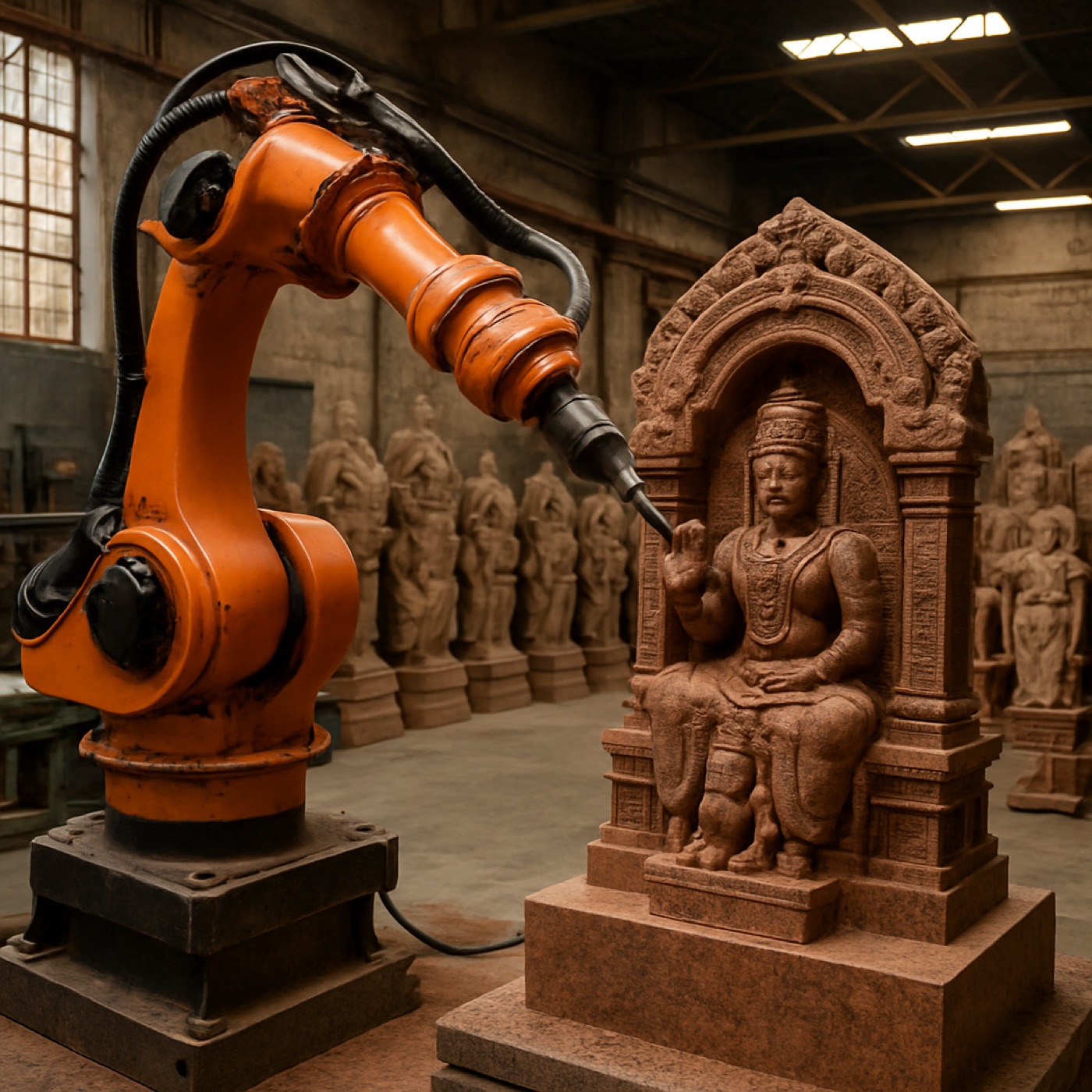
The robotic pass, to a tolerance no hand can hold. Photographed when it comes off the arm.
A shilpi finishes the surface over long hours. This is the stage that takes the time, and the one we film.
Sealed, numbered, certified, crated for its weight, and shipped insured to where it will stand.

Most of the distance between you and this workshop closes with photographs. We send them at each stage: the block as it was chosen, the rough form off the robot, the surface as the hand brings it up, and the finished work under the light before it is crated.
You are not waiting in silence for months and hoping. You are watching a thing be made.

Every finished work carries a Certificate of Permanence. It is not decoration. It is the record that lets anyone, now or in a century, know exactly what this object is and where it came from.
Each work is unique to its block
Stone work takes as long as the stone takes. Quarry supply, the grain of the block, and the hours a master needs at the bench are not things anyone can compress by wanting to.
So we do not quote a delivery date at the first conversation. We give you a schedule once the block is secured, when the variables that matter are known rather than guessed. From then on, if a date moves, you hear it from us before you have to ask. We accept only a few commissions a year precisely so that this stays true.
Currently booking Q4 2026
Work is crated for its own weight and centre of gravity, not to a standard size, and it ships insured. Large pieces travel by sea, which takes weeks rather than days, and we say so at the schedule rather than at the end.
We handle the export documentation, including the artist declaration and the certificate that travels with the work. Where a piece needs installing, we plan the lift and the fixing with you before it leaves the atelier, because a two tonne object is not something to improvise around on the day.
Every work ships insured. Photograph it before unwrapping further and write to us the same day. We handle the claim and the remedy. You should not be negotiating with a freight company about a sculpture.
The maquette and drawings you approved are the reference, and they are the standard we are held to. If the finished work departs from them in a way you did not agree to along the way, that is our failure to correct, not a conversation about taste.
Stone hides faults until you are inside it. It is uncommon, and it happens. If a block fails in carving we source another and carry that cost. You are commissioning a finished work, not buying a lottery ticket on a rock.
You hear it from us, early, with the reason and a revised date. A missed date told in advance is an inconvenience. A missed date discovered by the client is a broken trust, and we would rather lose the former than risk the latter.
There is no account manager, no ticket queue, and no form that disappears into a system. You write to hello@eternalart.co and the people who make the work write back.
That is possible because we take on few commissions. It is one of the reasons we intend to keep it that way.
Tell us what you have in mind. A few lines are enough, and nothing needs to be settled before we talk.